Audi A5 2021 – Transforming the base audio system into a full-fledged soundstage
The Audi A5 (F5 generation) is a car where everything is well-executed—from the materials and seating comfort to the low noise levels on the highway. Against this backdrop, the base audio system feels particularly lackluster. The client came to us with precisely this complaint: “The sound doesn’t match the car.”
Let’s break down what we changed, why we did it that way, and what the final result was.
What’s wrong with the stock audio?
The A5’s base audio system is built on the “just so it plays” principle:
- The doors house speakers with plastic baskets and small cones, operating within an untreated door cavity. The metal resonates, and the back wave bounces around the void, cancelling out the useful signal. This results in loose, indistinct bass lacking lower-midrange definition.
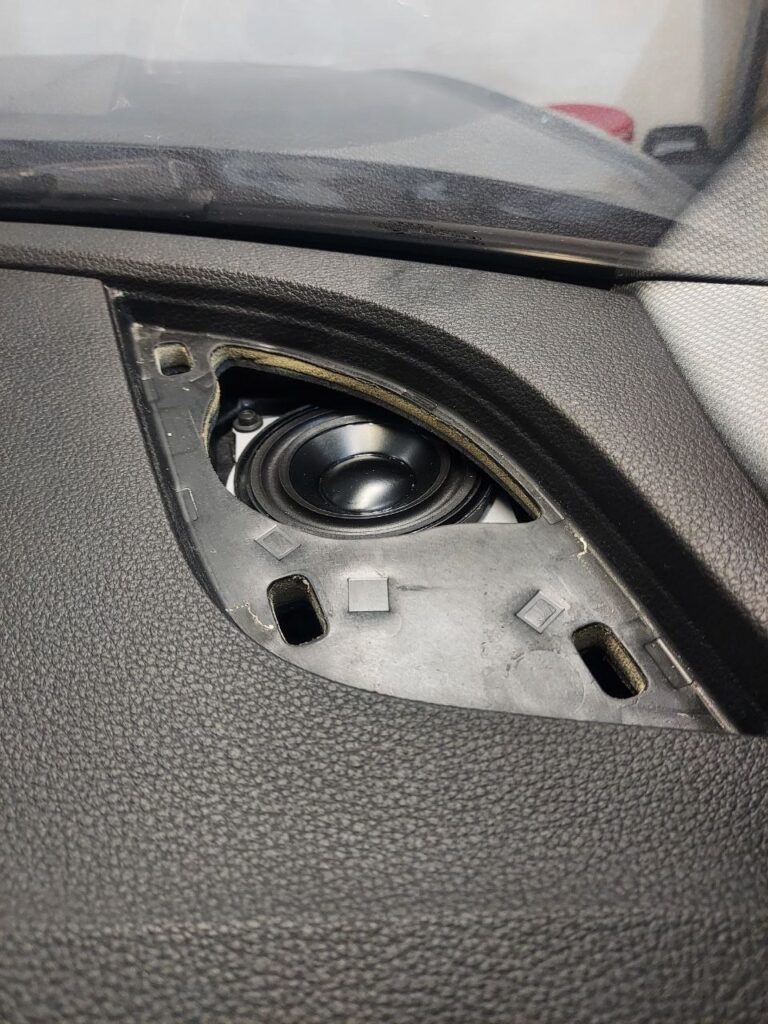
- The dashboard houses small tweeters that carry the entire high-frequency range and part of the midrange; they simply lack the physical capability to build a proper soundstage.
- The signal has a limited range and features factory processing and compensation tailored to specific stock speakers.
As a result, the soundstage is smeared across the bottom of the windshield, vocals seem to emanate from down by your feet, and the system starts to struggle at volumes above moderate levels.
Solution logic
We decided against the “direct speaker swap” approach. Instead, we redesigned the operating principle of the front-end system itself.
1. Dedicated 20 cm woofers for the front doors
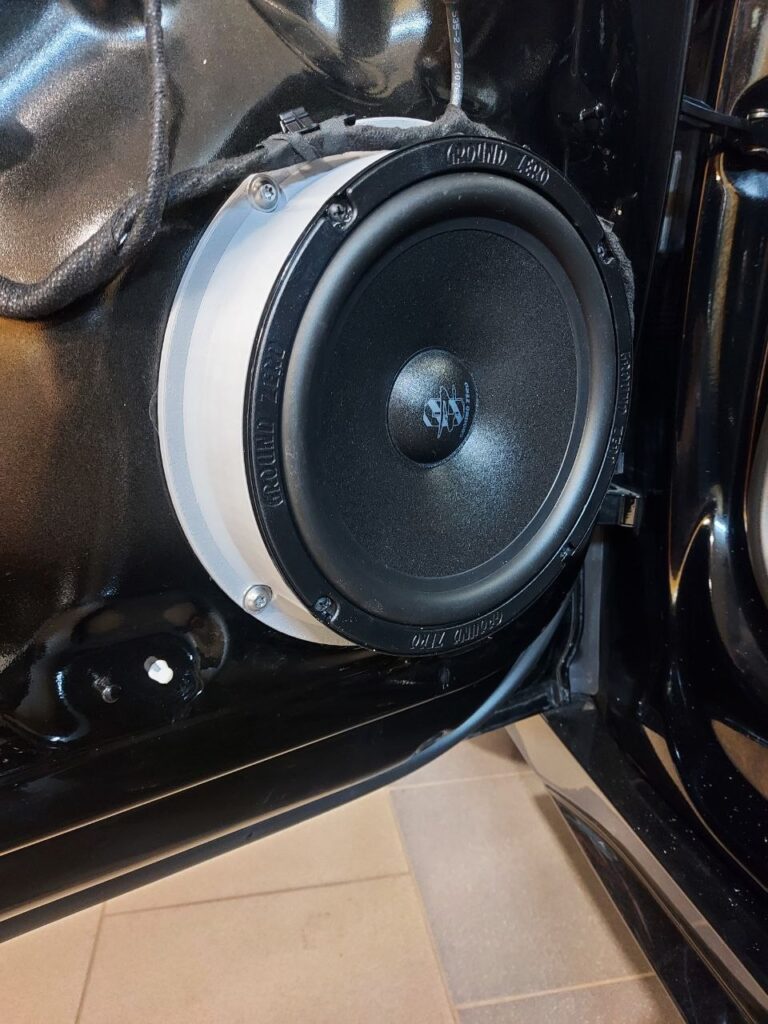
A 20 cm diameter—as opposed to the standard “pancake” drivers—means a fundamentally different cone surface area and a different volume of displaced air. The mid-bass ceases to be merely a “hint of bass” and becomes the foundation of the entire sound.
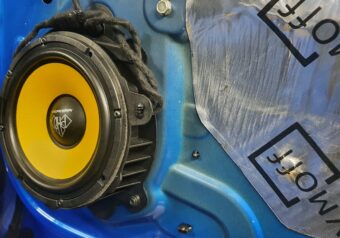
We installed the Ground Zero GZCS K-200VW from the “Car Specific” line—woofers designed for installation in the factory door locations of VAG vehicles. They feature a cast basket, a paper cone, and a proper magnet assembly instead of the stock plastic design.
2. Full-range drivers in the dashboard instead of tweeters
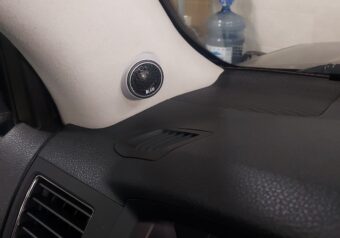
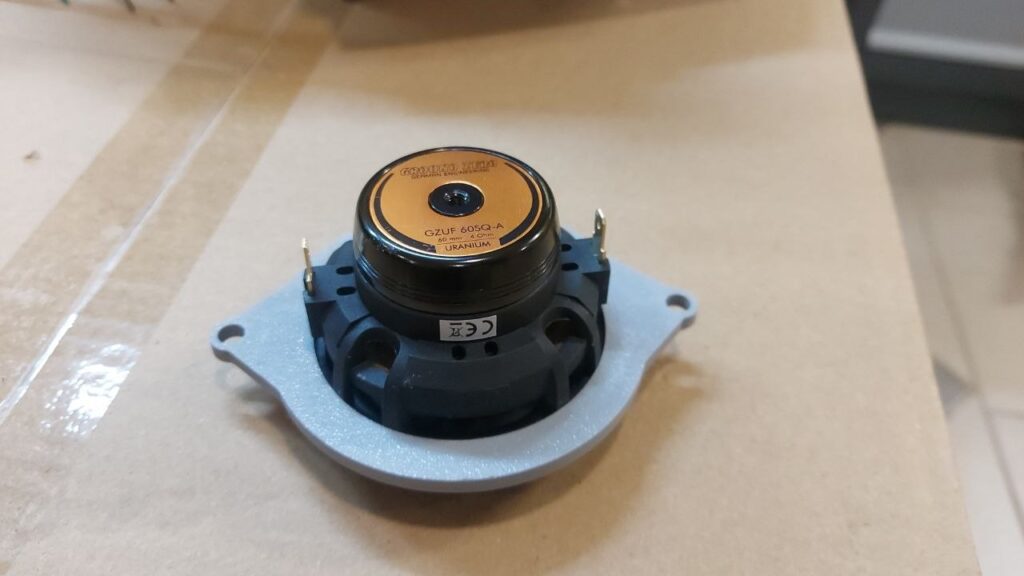
This is a key decision for the project. Ground Zero GZUF 60SQ-A drivers from the Uranium series—60 mm full-range units covering the mid-to-high frequency range—were installed in the factory tweeter locations.
What this offers:
- A single point of radiation for the entire mid- and high-frequency range. Vocals, guitar, and cymbals all originate from one place, rather than being assembled from two sources with different phases.
- There is no crossover in the most sensitive frequency range. The mid-to-tweeter crossover point typically falls between 2 and 4 kHz—a region where human hearing is most critical. By eliminating it, we also eliminated the characteristic “splicing” effect in vocals.
- The soundstage is positioned high up. The speakers in the dashboard are angled toward the windshield, so the sound image rises to the level of the hood rather than remaining low down.

3. Spacers for each speaker
The factory mounting locations do not fit the new speakers directly—neither in terms of diameter, depth, nor angle. We fabricated custom spacers for both pairs of speakers.
They serve several purposes at once: they establish the correct mounting diameter, provide rigid support around the entire perimeter, seal the joint against the metal door panel, and position the speaker at the required angle. The cheap “screw it in using washers” approach doesn’t work here—the speaker begins to vibrate along with the mount, defeating the entire purpose of the upgrade.
4. Zapco HB 810 II 8AD DSP amplifier
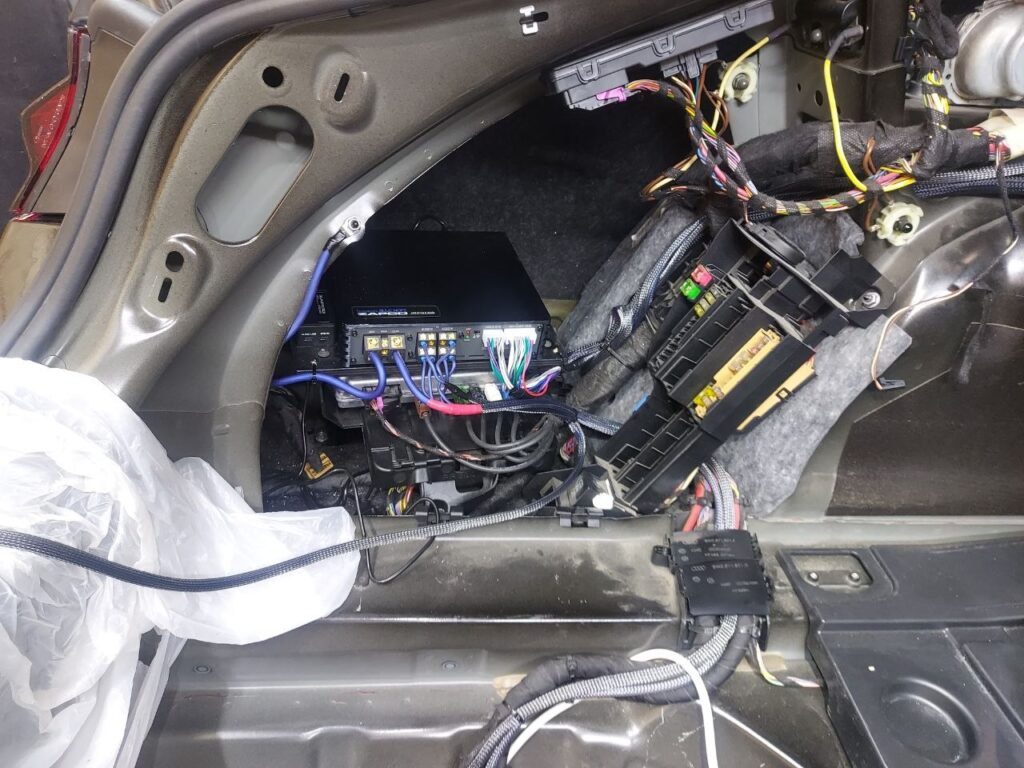
A compact 8-channel amplifier with built-in DSP. It addresses three tasks at once:
- It accepts the signal from the factory head unit via high-level inputs—without replacing the head unit itself. The entire MMI interface, steering wheel controls, and factory settings remain unchanged.
- Restores the signal: removes factory frequency compensation and reconstructs a full-range broadband stream.
- It configures the system—crossovers, time alignment, and per-channel equalization. It is precisely the time alignment that allows the soundstage to be “centered,” even though the driver is seated off-center.
It features a “hideaway” form factor: the amplifier is mounted in a recess within the trunk’s side trim, next to the factory fuse box. Nothing is visible from the outside, and trunk space remains unaffected.
5. Soundproofing of the front doors
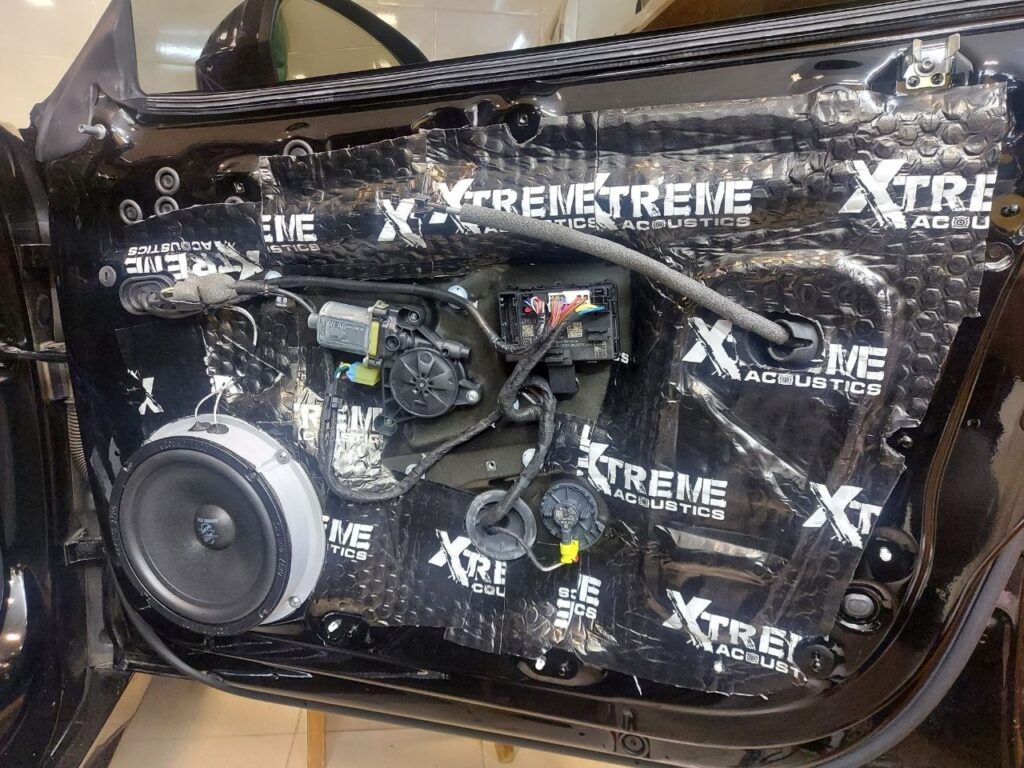
We treated both doors with Xtreme Acoustics material—covering the outer and inner metal panels as well as the area around the speaker. Without this, the 20cm woofer operates inefficiently, as some of the energy is lost to panel rattle and unwanted resonances.
This is not a “quietness option,” but an essential part of the acoustic design. The door is transformed from a hollow, tinny box into something resembling a proper acoustic enclosure, and the mid-bass finally gains a solid foundation.
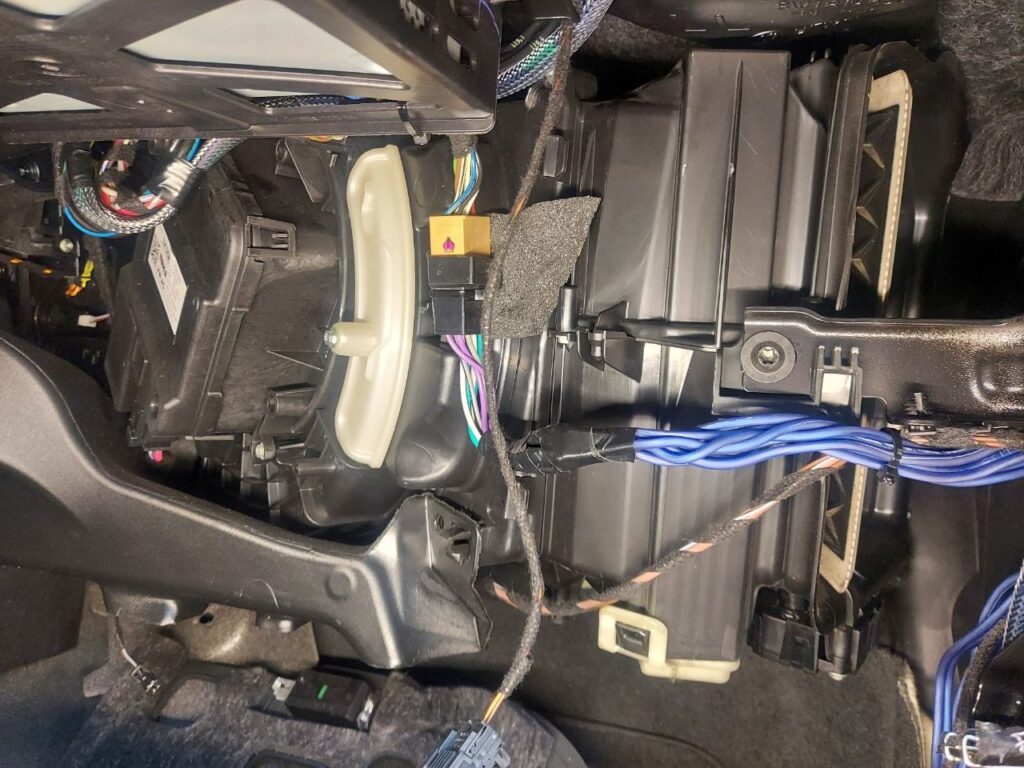
6. Wiring
A complete power and speaker wiring kit of the appropriate gauge, featuring a battery-side fuse and proper grounding. The wiring run from the amplifier to the front speakers follows the OEM channels alongside factory harnesses, with secure fastening and protection at all points where the cables pass through the vehicle body.
Skimping on this aspect is the most common cause of noise, voltage drops, and strange system behavior at high volumes.
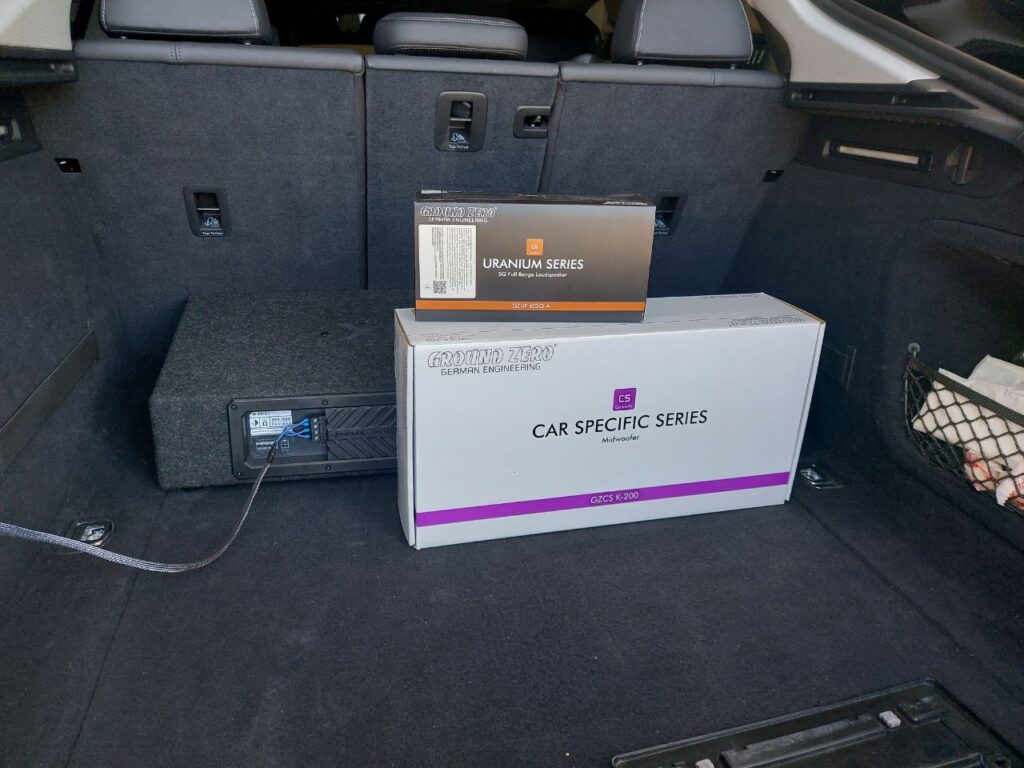
Subwoofer: slim enclosure for the trunk
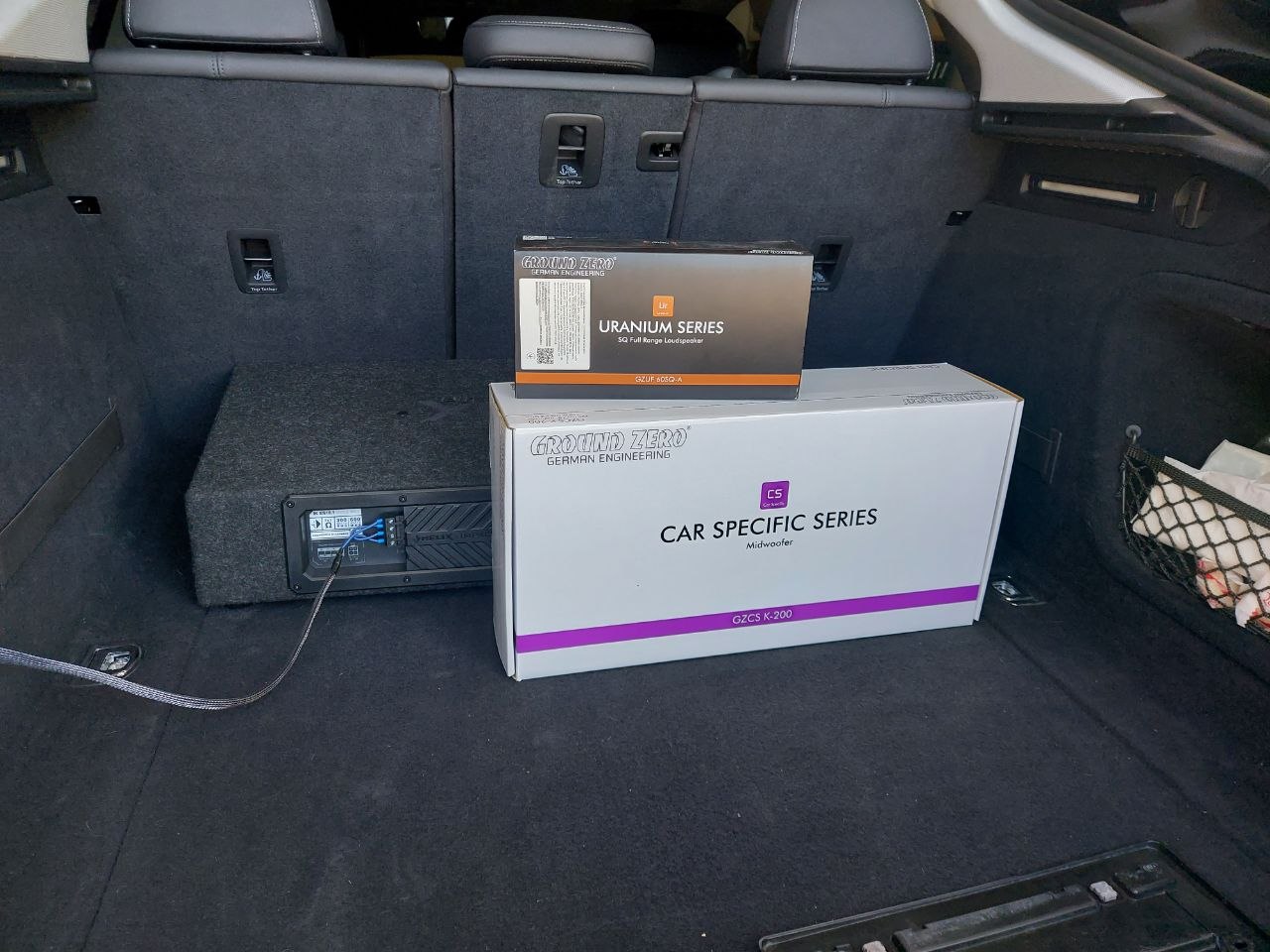
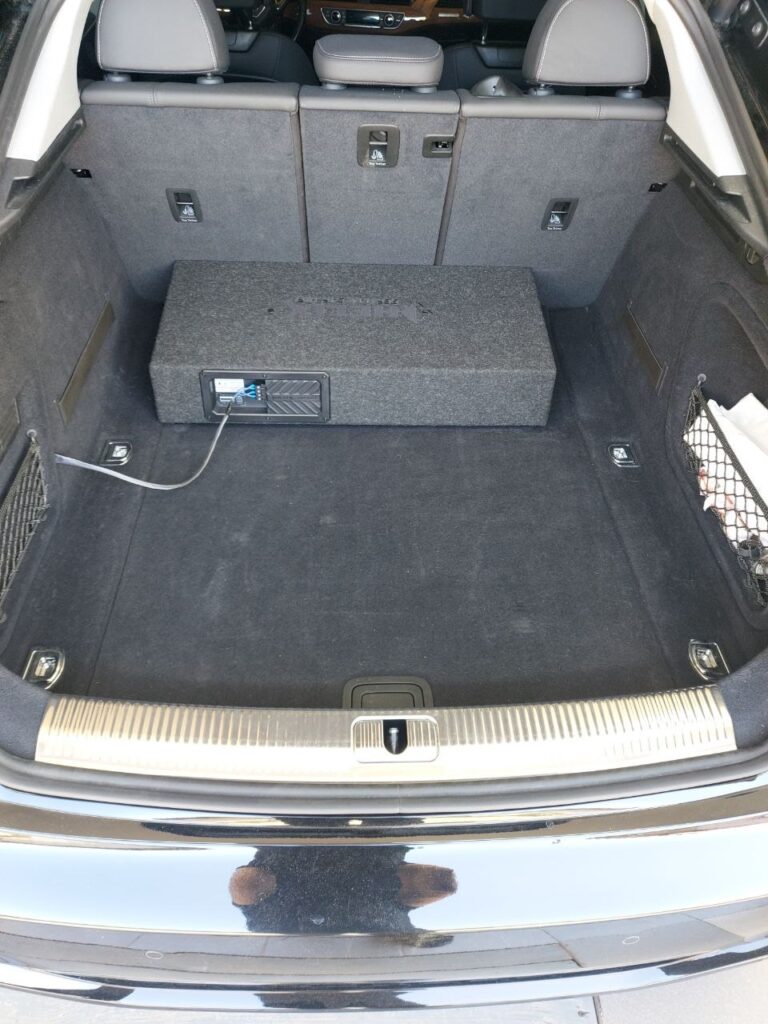
The front system, featuring 20cm woofers, performs confidently, but the sub-bass range below 50–60 Hz is beyond its capabilities. Consequently, a slim, enclosed subwoofer with a built-in amplifier was added to the trunk.
The flat enclosure design was chosen deliberately: it sits flush against the rear seatback, taking up minimal depth. The A5’s trunk remains fully usable—the subwoofer occupies only a narrow strip against the seatback, so the cargo floor area is not lost.
The subwoofer is phase-aligned with the front speakers so that the low frequencies do not “lag” behind the main soundstage or pull the image backward.
Configuration
The final stage—and the longest in terms of time. Workflow:
- Frequency band division. Woofers, full-range drivers, and the subwoofer receive their respective frequency ranges with the correct crossover slopes.
- Time delays for the driver’s seat position — to ensure the signals from the left and right channels reach the listener simultaneously.
- Channel-specific frequency response correction based on measurements. The vehicle interior introduces its own coloration, so measurements are essential.
- Checking against reference tracks and final adjustments by ear.
It is at this stage that a set of good iron turns into a system.
Result
- The soundstage rose to the level of the windshield, and the vocals were centered rather than coming “from the left door.”
- The lower midrange and a distinct mid-bass attack emerged—things that are completely absent in the stock setup.
- The high frequencies have become detailed but not harsh: the full-range driver does not accentuate the “grit” on consonants.
- The system maintains the volume level without compression or distortion.
- The trunk remains fully functional, and the MMI interface is the factory original. Visually, nothing in the cabin betrays the modifications.
Scope of work and cost
| Position | Price |
|---|---|
| Zapco HB 810 II 8AD Processor-Amplifier | 22 500 грн |
| Ground Zero GZUF 60SQ-A wide-range drivers | 6 600 грн |
| Ground Zero GZCS K-200VW 20 cm front door woofers | 6 400 грн |
| Spacers | 1 900 грн |
| Soundproofing for 2 doors | 9 000 грн |
| Wires | 4 500 грн |
| Installation of amplifier and speakers, and system tuning | 17 800 грн |
| Total | 68 700 грн |
A universal subwoofer for this set costs an additional 14,600 UAH.
Complete set with subwoofer: 83,300 UAH.
Who is this solution suitable for?
The “20cm woofer + dashboard full-range driver + DSP amplifier” setup is versatile and works well not only in Audi vehicles. It is a suitable choice if you:
- you want a significant leap in quality, not just a cosmetic improvement;
- not ready to replace the factory head unit and lose the original interface;
- value a smooth, fair stage more than loudness for loudness’s sake;
- you want to preserve trunk space.